Our previous article explored how Base Price Models work — the industry-standard pricing model for short-term rentals. It’s a reliable, scalable model that makes your nightly rates fluctuate with the market. What it doesn’t do is optimize pricing for maximum revenue. That’s where this article picks up.
What “Optimization” Actually Means
Optimization means something different in mathematics than in conversation. Colloquially it means “make something better.” In revenue optimization, it means solving a function to find the point of highest expected revenue. That’s the meaning used throughout this article, and it’s the core distinction between the industry-standard Base Price Model and an optimization model: one adjusts prices logically, the other computes the mathematically best price.
The $250 Seat or the $115 Seat?
The first interview I ever had for a revenue management position was as an analyst at Frontier Airlines. The most important question they asked: which would you prefer?
- Pricing a seat with a 50% chance of booking at $250
- Pricing a seat with a 90% chance of booking at $115
The revenue management answer to the question is solved by multiplying the probability by the price. The first option has a 50/50 chance of occurring — half of the time, you will get $0. That outcome is what scares most people. But the second option, although more likely, has a lower expected return.
50% × $250 = $125
90% × $115 = $103.50
Probability-based pricing is built on exactly this reasoning, applied to every night on your calendar.
Rules-Based Models: Logical, but Not Optimal
Base Price models belong to a different family: rules-based pricing. Instead of probabilities, prices are set by if-then criteria — start with a base, then “if season = X, change price by Y.” These adjustments are usually sensible, but the model never asks which price has the highest expected outcome. That isn’t its objective. It’s a heuristic, not an optimization.
Why Airlines Went to Rules — and Came Back
In the mid-2010s, airline revenue management actually trended toward rules-based systems. Probability estimates from optimization models had degraded — low-cost carriers and capacity swings shook the data — and these models are heavy and expensive to run, so the market sought alternatives. The STR industry, structured differently but facing similar data problems, settled on business rules around the same time.
The biggest airlines never switched, because they had analyst teams correcting the data and deep investments in their models. At Virgin America, we started on an optimization model, transitioned to rules for all the reasons above, and eventually built a hybrid that reincorporated optimization. The trend back was driven by one thing: when set up correctly, optimization models simply make more money.
The Single-Listing Problem
A hotel can be 89% full. A vacation rental is booked or vacant — there is no 89% full Friday night at the listing level. Estimating booking probability per listing is possible, but the historical data is messy: owner stays, cleaning blocks, maintenance blocks. The bigger problem is that with one unit, there’s no opportunity to re-forecast and recover if demand materializes differently than expected. Traditional final-demand forecasting — the kind airline models use — works poorly against binary inventory. A rules-based model can genuinely outperform a badly-fed optimization model here.
What Quibble Forecasts Instead: Shopper Choice
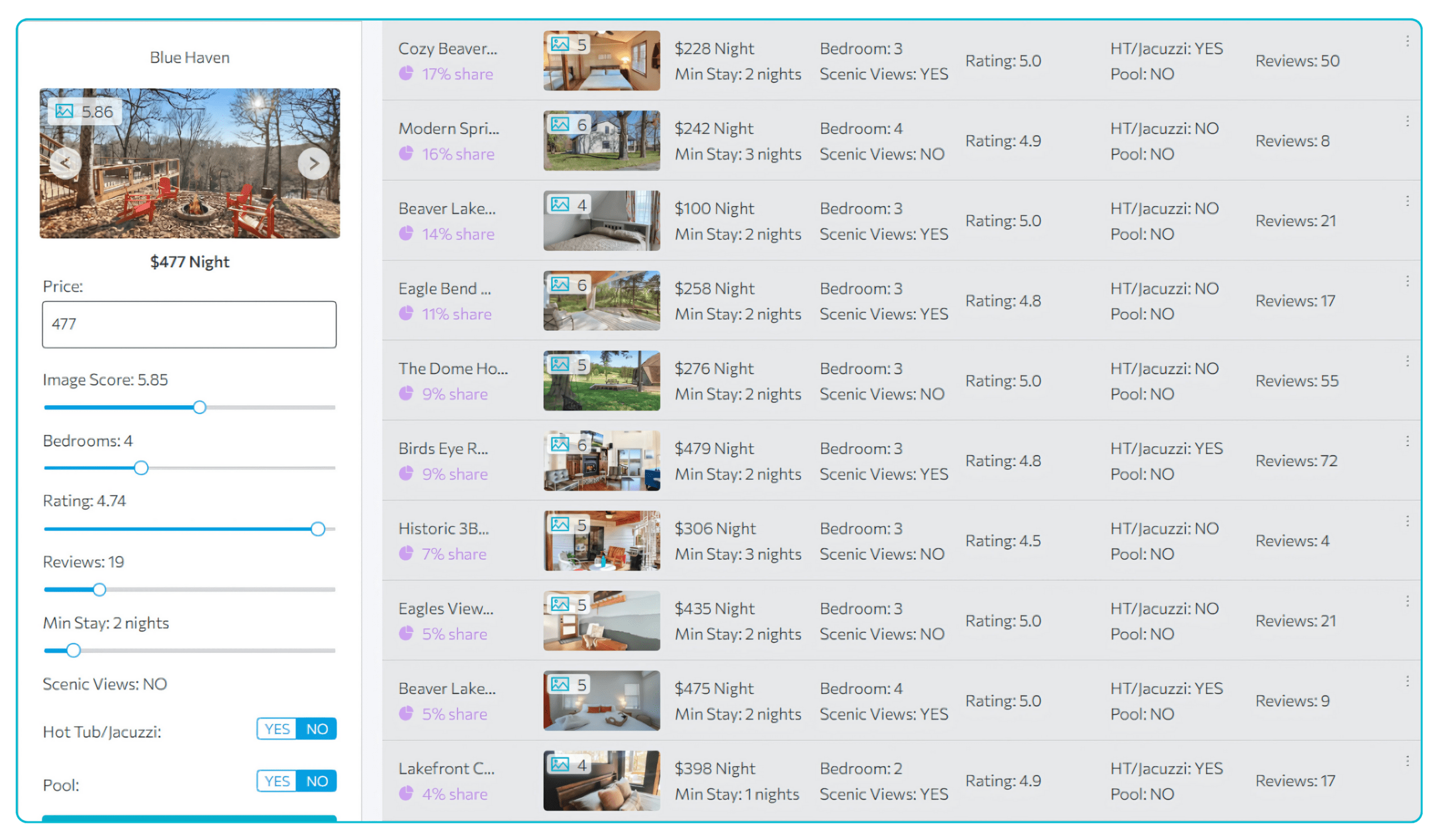
Quibble’s model forecasts something different: the choice a shopper makes when your listing appears on their screen. Your listing shows up in front of many shoppers, many times — each appearance is a chance to get booked. The model estimates the probability of you winning that choice, and the probability of each of your direct competitors winning it instead.
This is exponentially more complex than rules or traditional revenue management, and the payoff is twofold: pricing that maximizes expected revenue, and visibility into how to raise your market share against specific competitors.
Finding the True Maximum
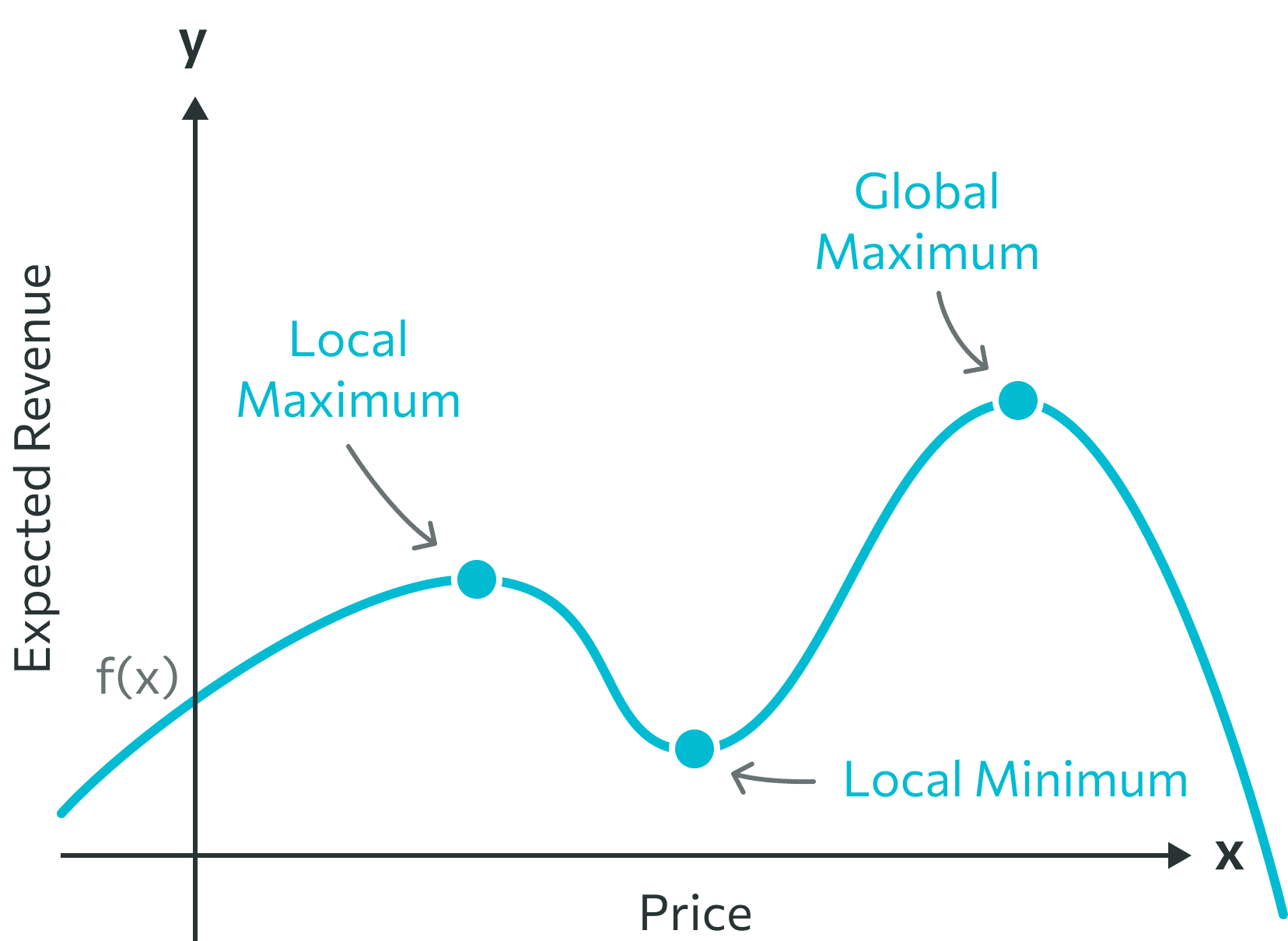
Optimization models earn their name by testing the expected revenue of every possible price point until they find the maximum. The complication: changing your price changes the probability of being chosen — yours and your competitors’. Plotted graphically, expected revenue rises to a local maximum where a lazy search would stop, because moving in either direction decreases revenue. Pushing past it can reveal a higher global maximum — the truly optimized price for that night. This problem is solved every night, for every property.
Adopting Optimization
Moving from manual pricing or a Base Price Model to an optimization model adds complexity — implementation takes real setup work with our team. But the gains are significant, both in pricing and in optimizing the listing itself. See how it plays out in the End of Base Price case study, or start with the broader picture in our price optimization guide.
Frequently Asked Questions
What is a price optimization model?
A model that mathematically solves for the price with the highest expected revenue. It tests the expected revenue of every possible price point and selects the maximum — unlike rules-based systems, which adjust a base price using if-then logic.
How is optimization different from dynamic pricing?
Dynamic pricing makes prices move; optimization makes them move to the revenue-maximizing point. Most dynamic pricing tools are rules-based: logical, but not optimal in the mathematical sense.
Why don’t most STR pricing tools use optimization?
Optimization models are heavy: they require granular forecasts, significant processing, and careful setup. Rules on a base price are simpler to build and scale, which is why the industry standardized on them a decade ago.
What does Quibble’s model actually forecast?
Shopper choice: the probability that a guest books your listing when it appears on their screen versus your competitors. That sidesteps the binary booked-or-vacant problem that breaks traditional demand forecasting at the single-listing level.
Want to see the model price your listings? Book a demo or start a free trial.




 Quibble © 2025. All rights reserved.