AI probably isn't going to wipe out our civilization. It is wiping out parts of our language, though, and in short-term rental revenue management it has already started on one of our most useful words: Pace.
Ask an AI tool to summarize your portfolio's performance and you'll likely read something like "October is pacing 8 points behind last year." That sounds sensible, but it isn't pace. It's gap.
Where pace comes from
Pace isn't a term invented for this post. It comes from airline revenue management, where it was built to answer one question: are bookings for a future flight coming in faster or slower than they did at the same point last year?
That's where I learned it. I started in 2011 as a revenue management analyst at Frontier Airlines, then spent nearly five years on the Revenue Strategy team at Virgin America, first as a senior analyst and then as team leader. In 2016 I founded PasRM and built a real-time airline revenue management system. Pace was built into it as its own metric, separate from on-the-books versus last year, because each one answers a different question.
Short-term rental revenue management borrowed a lot from the airlines, including dynamic pricing. The word "pace" came over too, but its meaning got lost along the way.
Where the AI learned it
Large language models learn what words mean from how people use them. They don't know what "pace" should mean. They know what it means across millions of pages of text.
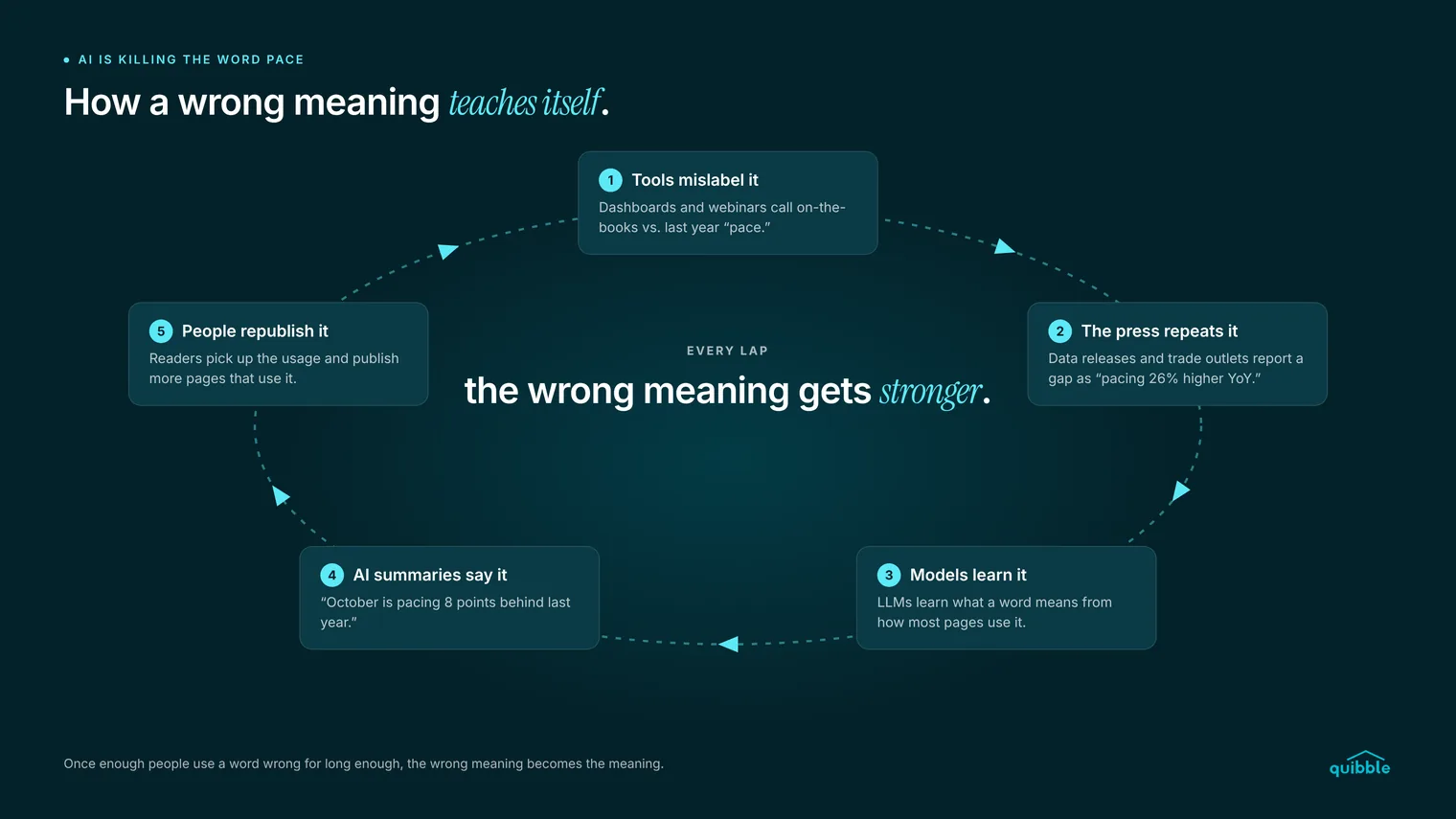
In STR revenue management, most of those pages come from vendors, dashboards, webinars and commentators. Many of them use "pace" to mean "how far ahead or behind we are on the books." So the model learns that meaning and repeats it in every summary, report and chatbot answer it writes.
Pricing tools and RM commentators drive most of this. Open the "pace" report in most dashboards and you'll find on-the-books occupancy plotted against the same date last year. Sit through most revenue management webinars and you'll hear "we're pacing behind" used for the same snapshot. Neither one measures how fast bookings are coming in.
Industry data releases do the same thing. In July 2026, a KeyData market report described U.S. vacation rental revenue for September as "pacing 26% higher YoY." The number was on-the-books revenue as of mid-July compared with last year. That's a gap. Trade outlets ran the story with the same wording, and every copy became one more example for the next model to learn from.
People read the AI's output, pick up the wrong usage, and publish more content with it. That content trains the next model. Each round makes the wrong meaning stronger.
Once enough people have used a word incorrectly for long enough, the incorrect meaning becomes the meaning, and the original one is gone. We could lose the only common word we have for a metric that matters.
Gap and Pace are different measurements
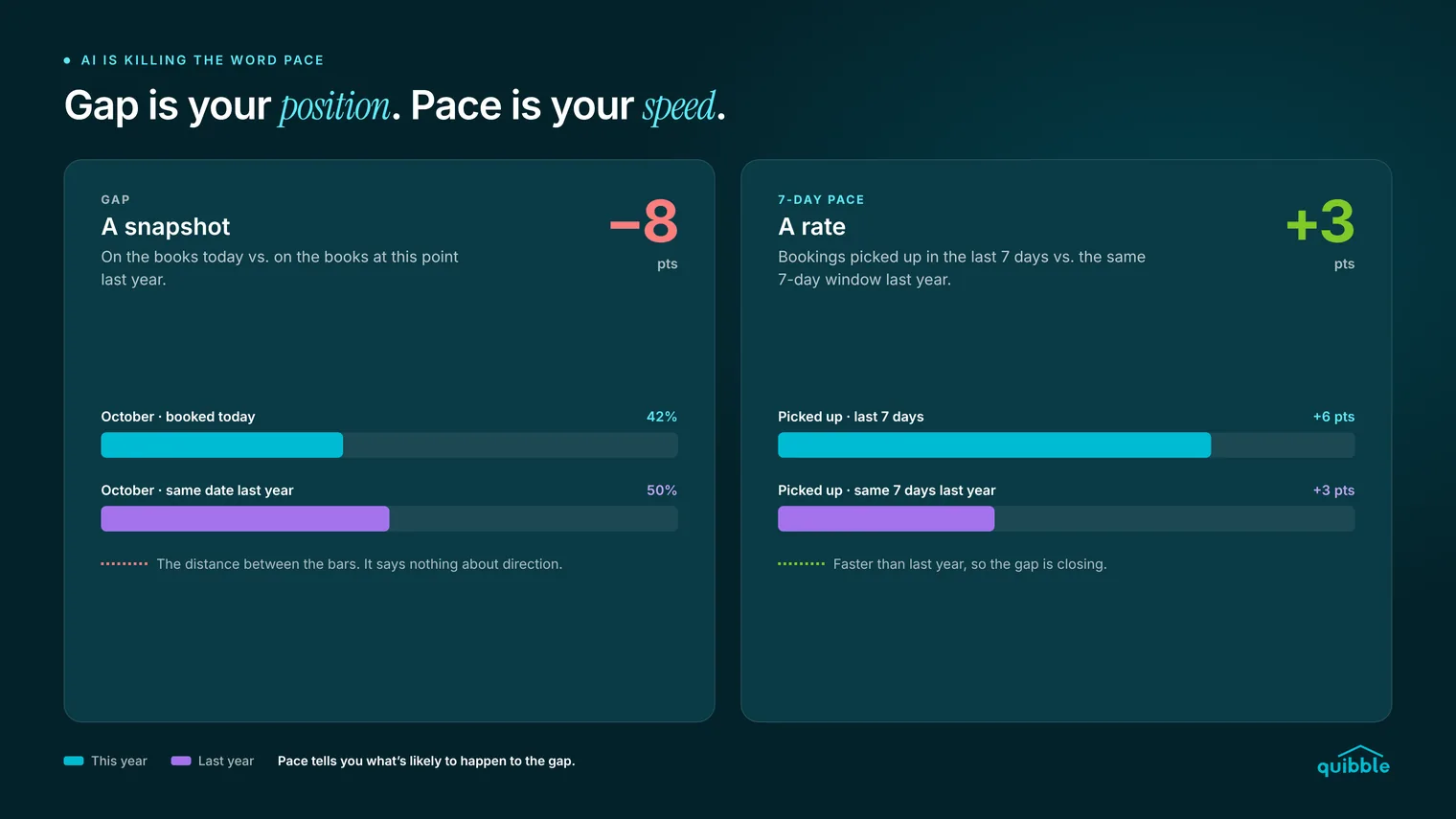
Gap is a snapshot. It compares what's on the books today for a current/future period with what was on the books at the same point in time last year.
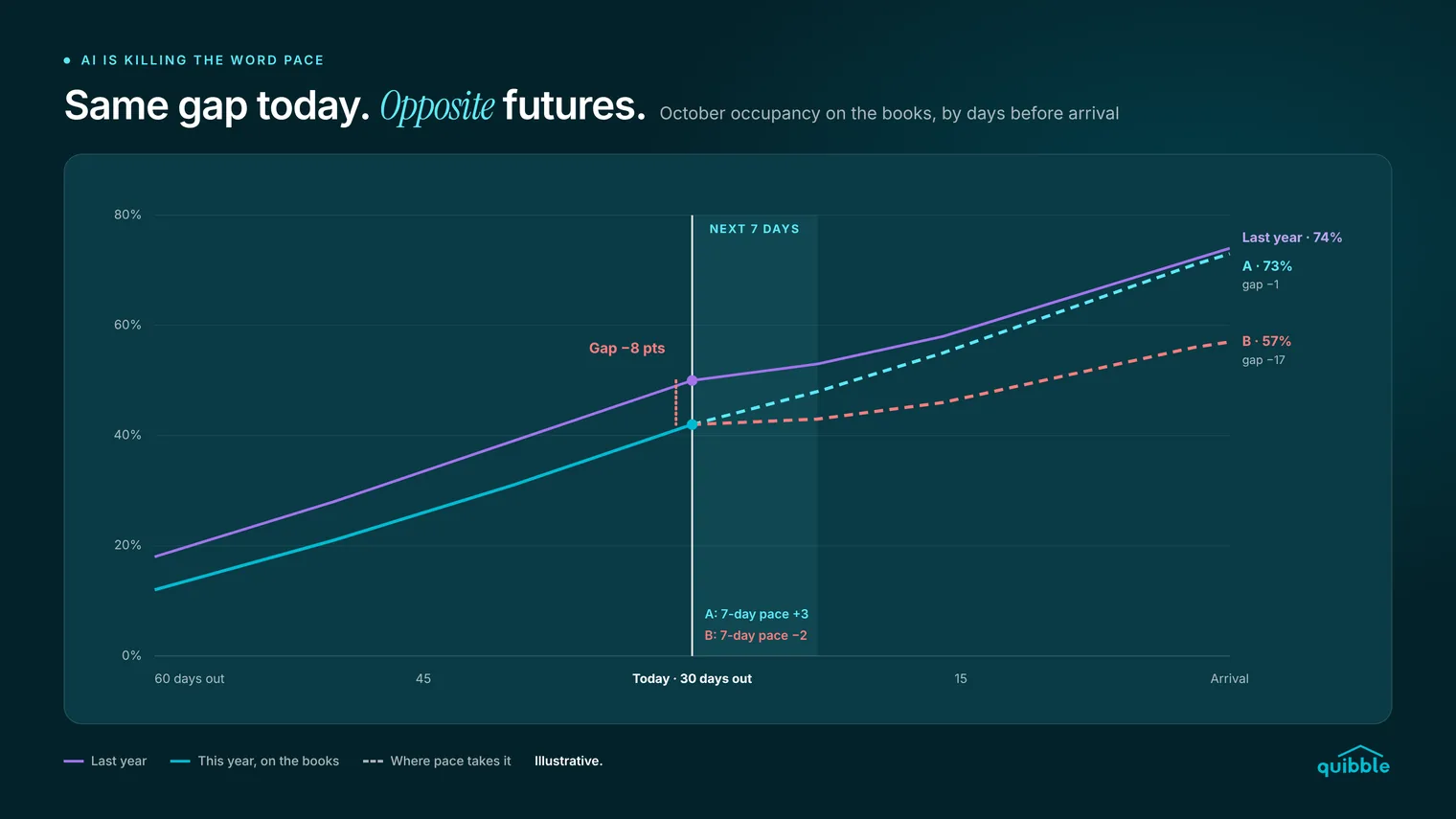
October is 42% booked today. On this date last year, October was 50% booked. Gap: −8 points.
Gap tells you where you stand, and that's useful. It can't tell you where you're headed.
Pace is a rate, and it's measured over a window of days. 7-day pace compares the bookings you picked up for a period over the last 7 days with the bookings picked up over the same 7-day window last year. 14-day and 21-day pace work the same way over longer windows.
In the last 7 days, October picked up 6 points of occupancy. In the same 7 days last year, it picked up 3. 7-day pace: +3 points.
Gap is your position. Pace is your speed compared with last year's speed.
Pace tells you what's likely to happen to the Gap.
Think of it as a race
The easiest way to see the difference is on a race track. Picture two cars. One is your property this year. The other is the same property last year.
The gap is the distance between the two cars. Freeze the race at any moment and you can measure it: you're 8 lengths back, or 5 lengths in front.
The gap alone doesn't tell you what happens next. That depends on speed. If both cars are going exactly the same speed, the gap stays the same. If your car is faster, the gap closes. If it's slower, the gap grows.
Pace is the comparison of speeds. It's how quickly you're picking up bookings now compared with how quickly you picked them up at the same point last year. Pace tells you what will happen to the space between the cars.
No race commentator would describe the distance between two cars as their speed. A car 8 lengths back and gaining is in a different position from a car 8 lengths back and fading. Yet that's the mistake most pricing tools and RM commentators make when they say a month is "pacing behind." They report the distance, call it speed, and miss what pace is telling them about where the race is headed. Every report and post that repeats the mistake teaches the AI models the wrong meaning a little more firmly.
Why the difference matters
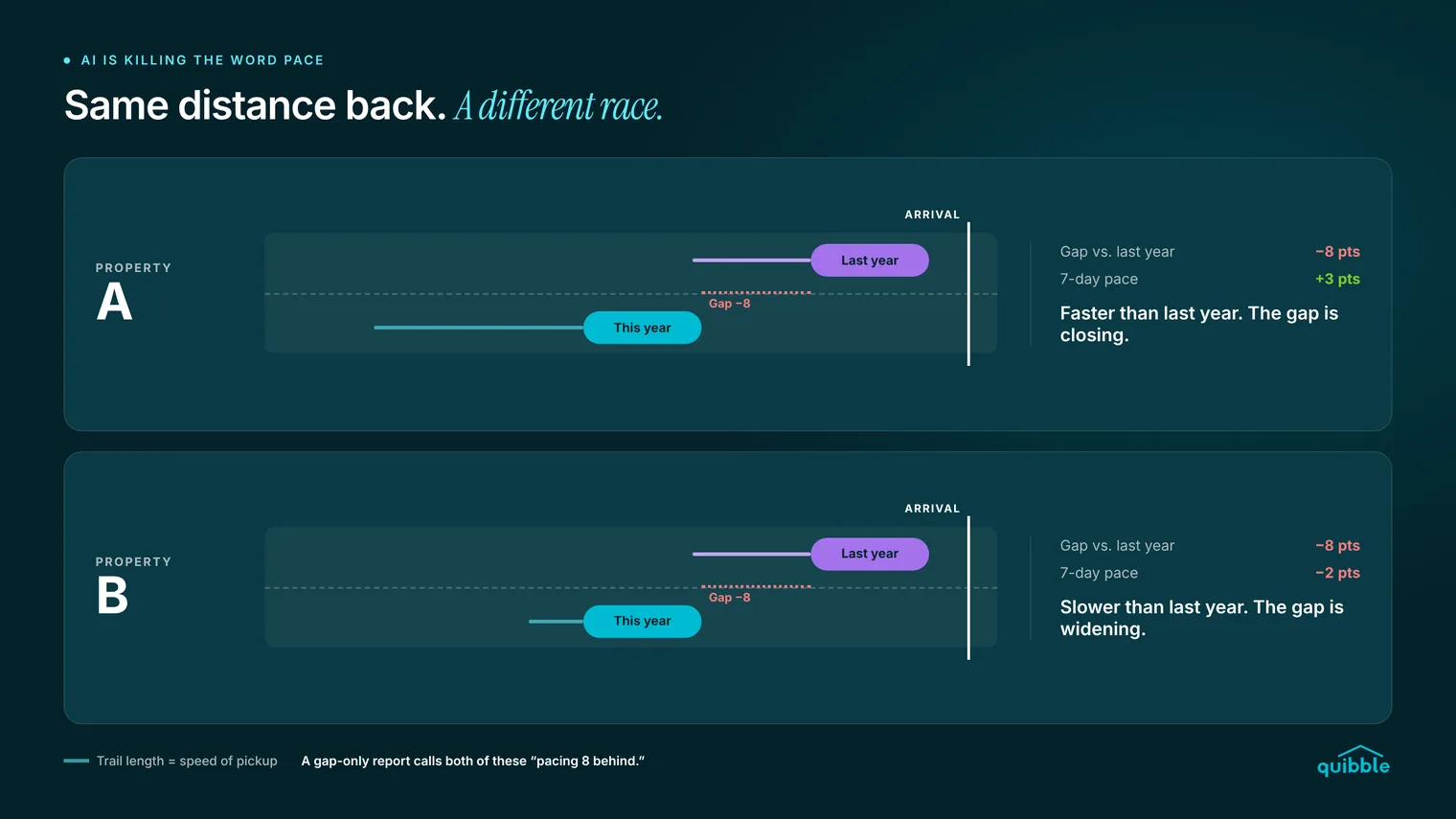
Take two properties with the same Gap:
| Property | Gap vs. STLY | 7-day pace | What's happening |
|---|---|---|---|
| A | −8 pts | +3 pts | Behind, but catching up. The gap is closing. |
| B | −8 pts | −2 pts | Behind and falling further behind. The gap is widening. |
A report that only says "pacing 8 points behind" treats these two properties as the same, but they call for opposite responses.
- Property A may need nothing. Demand is arriving faster than last year. Cutting rate here gives away revenue you were about to earn anyway.
- Property B needs attention now. It's behind, and the trend is making things worse. Waiting costs you.
In race terms, both cars are 8 lengths back. Car A is going faster than last year's car and closing in. Car B is going slower and dropping further back.
Now take a property that's ahead of last year, say +5 points, with negative pace. The Gap looks healthy, but Pace tells you the lead is shrinking. If you look only at the Gap, you won't see the lead shrinking.
Four situations, four responses
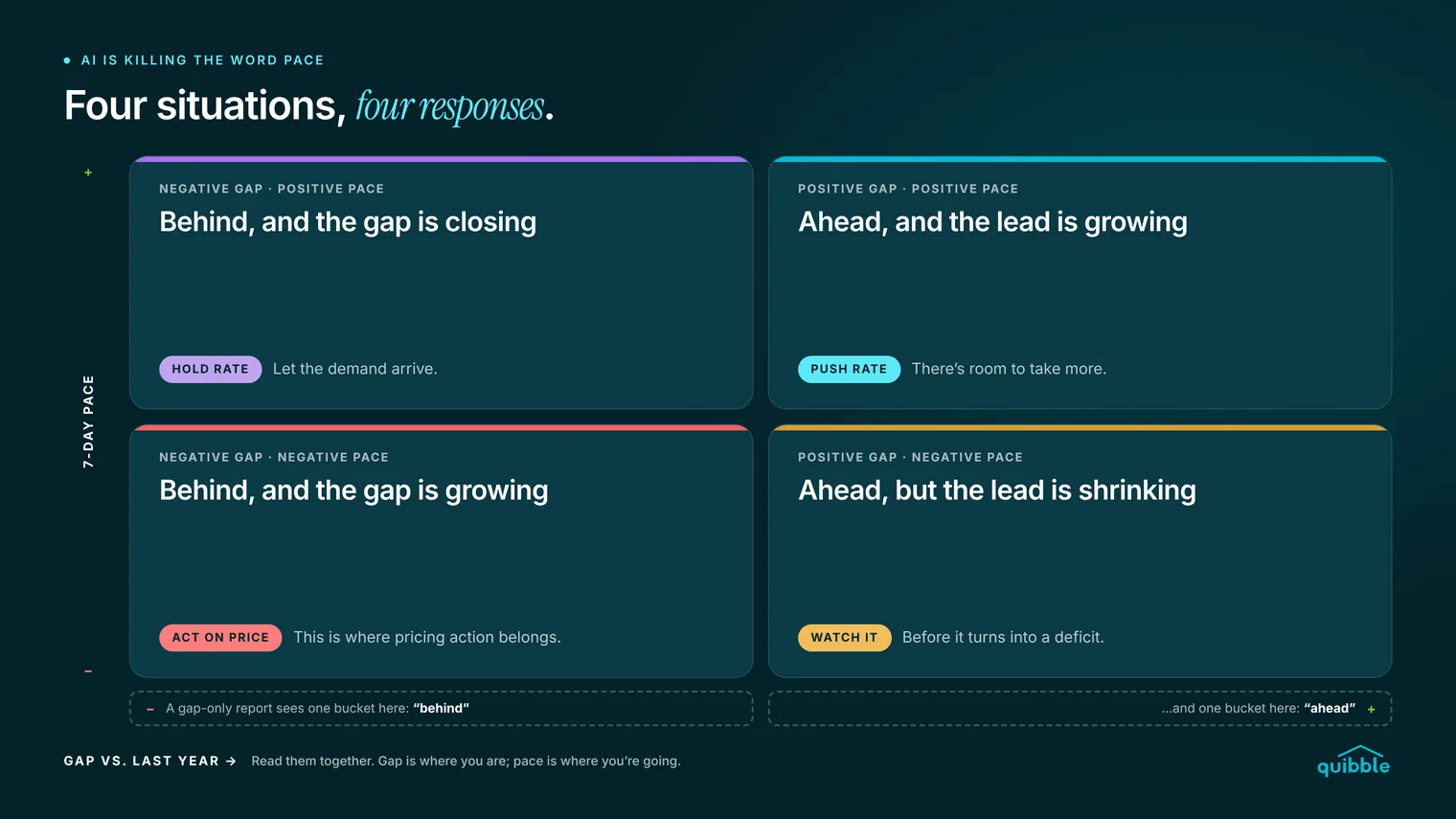
Put gap and pace together and every period lands in one of four situations. Each one calls for a different move.
- Negative gap, positive pace: You're behind, but faster than last year, so the gap is closing. Hold rate and let the demand arrive.
- Negative gap, negative pace: You're behind and slower than last year, so the gap is growing. This is where pricing action belongs.
- Positive gap, negative pace: You're ahead, but slower than last year, so the lead is shrinking. Watch it before it turns into a deficit.
- Positive gap, positive pace: You're ahead and faster than last year, so the lead is growing. There's room to push rate.
A gap-only report sorts every period into two buckets, ahead and behind. It can't tell the first situation from the second, or the third from the fourth.
That's why pace is its own metric. It shows which way the Gap is moving before the Gap changes.
What we lose if the word goes
When "pace" means gap, three things go wrong:
- The metric disappears from the conversation. If no word refers to it, people stop asking for it. Dashboards stop showing it. Revenue managers stop checking it.
- Decisions get made on position alone. Pricing moves based only on gap react to what already happened. You end up discounting properties that were already recovering and missing the ones that are sliding.
- Nobody notices the confusion. Two people can discuss "pace" and mean different things, each sure they agree. AI summaries make this worse because they sound confident.
How to protect the word
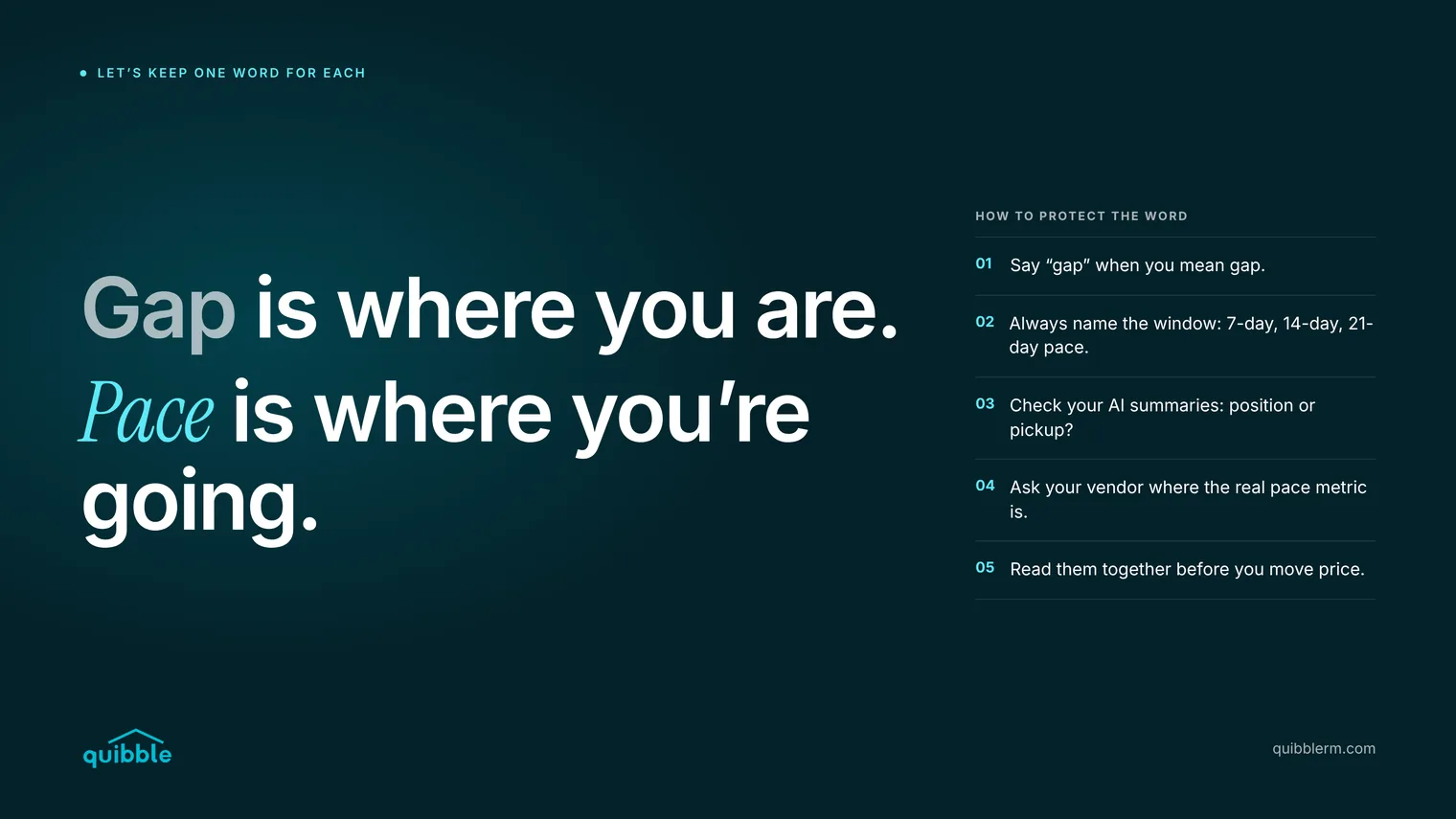
- Say "Gap" when you mean gap. On-the-books versus same time last year is a gap. Call it that.
- Always name the pace window. "7-day pace" and "21-day pace" are clear. "Pace" by itself invites confusion.
- Check your AI summaries. When an AI tool says a period is "pacing behind," ask whether it means position or pickup. Usually it means position.
- Ask your vendors. If your dashboard's "pace" chart is really on-the-books versus last year, that's a gap chart. Ask where the real pace metric is.
- Read them together. Gap tells you where you are. Pace tells you where you're going. You need both to make a good pricing decision.
The bigger point
Language drift isn't new. What's new is the speed and scale. AI takes whatever usage is most common and repeats it millions of times, so it establishes a meaning quickly, whether or not that meaning is correct.
In a field as specialized as revenue management, the people who use the words carefully are few compared with the people who use them loosely. If practitioners don't use "pace" correctly, the models will keep using the wrong meaning until it becomes the standard one.
Gap is where you are. Pace is where you're going. Let's keep one word for each.